THE SCHEME
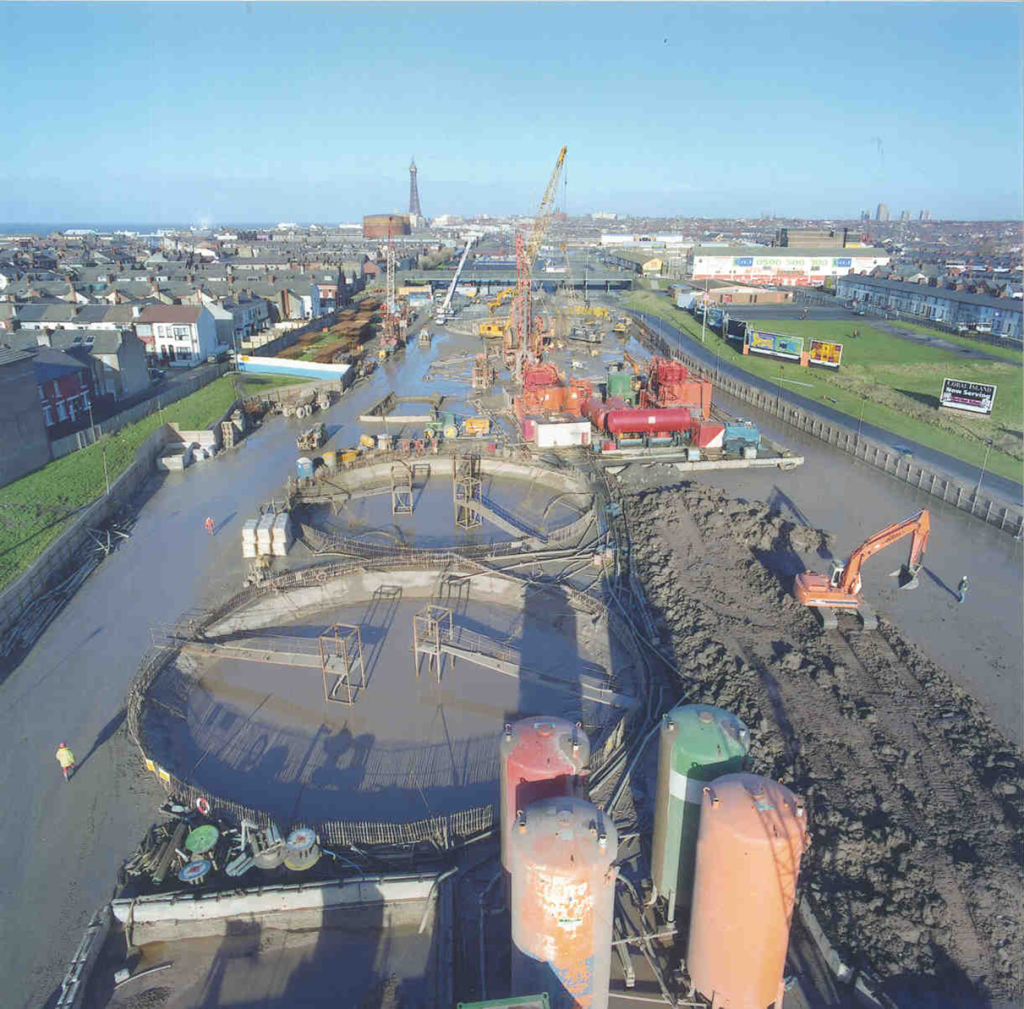
The North West Water Bathing Water Programme II, valued at approximately £100 million, included a number of co-ordinated contracts targeting coastal water improvements along the Flyde coast. The purpose of the programme, in the Blackpool area, was to reduce the volume of stormwater effluent entering the bathing waters, from three major pumped storm sewage outfalls.
At Blackpool, North West Water (now United Utilities) awarded Bachy Soletanche the £10 million main civil engineering contract to design and construct the diaphragm walls, bases and roofs for the two circular wastewater storage tanks.
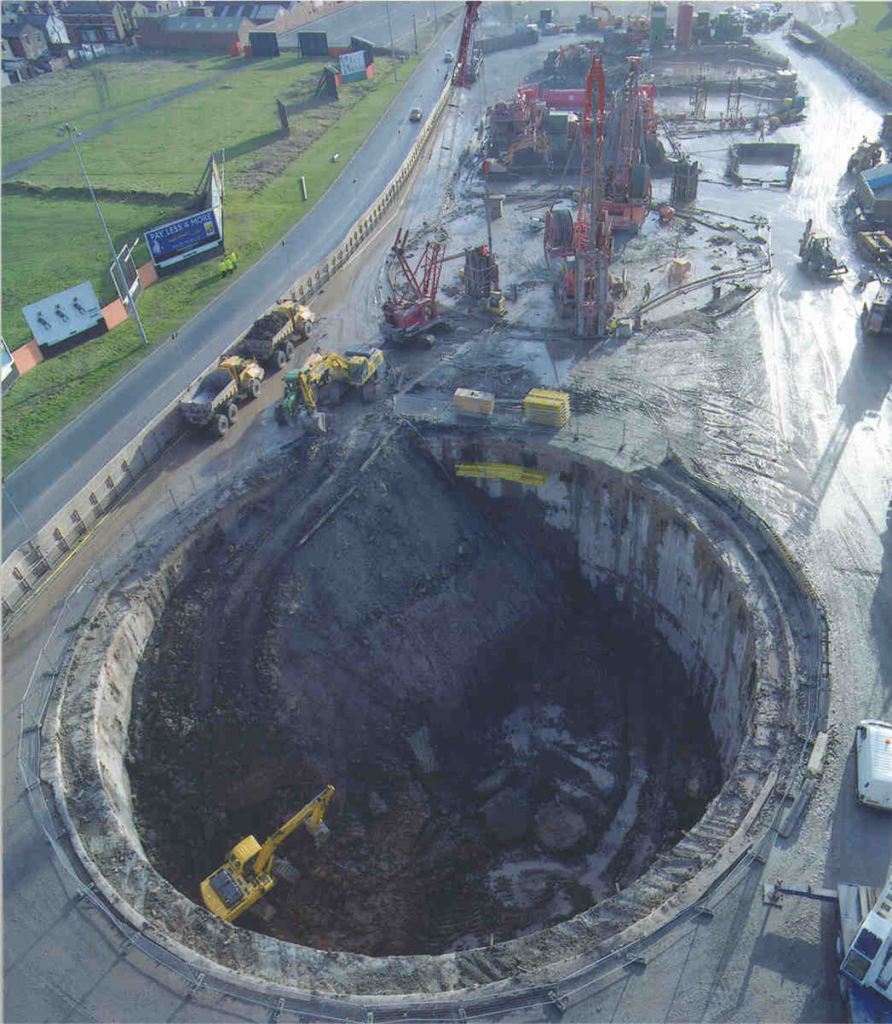
The initial design and sizing of the tanks were undertaken by Bechtel, North West Water’s engineering partners. Each tank is 36 metres in diameter and 40 metres deep, when combined they provide storage of 60,000m³ of stormwater effluent.
PILING OPERATIONS
Two Hydrofraise drilling machines were being used at Blackpool by Bachy Soletanche to excavate the 1.5m diaphragm wall panels to the required 45m depth, under Bentonite suspension.
During operation, the Hydrofraise is guided by its metal frame, which incorporates deviation measuring instrumentation. The frame has two cutter drums equipped with tungsten carbide tipped cutters, which rotate in opposite directions, in order to break up the soil. A pump placed immediately above the drums evacuates the loosened soil, which is carried to the surface by bentonite drilling mud. The mud is continuously filtered to remove the suspended cuttings and then poured back into the trench.
The Hydrofraise assembly is mounted on the heavy crawler crane, which incorporates the hydraulic power unit. The hydraulic output is transmitted to three down-the-hole motors, two of them driving the cutter drums and the third one operating the circulation pump.
A special feature of the Hydrofraise, one which was integral to the design at Blackpool, is that the cutting tool is capable of penetrating the concrete of a panel that has already set. It is therefore possible to achieve good joints without using a conventional stop-end when carrying out the construction of alternate panels.
The diaphragm wall construction for both tanks finished in January 1999, whereupon bulk excavation commenced.
TUNNEL OPERATIONS
The design incorporated a 17m long, low level interconnecting tunnel with a 1.8m internal diameter. Tunnel construction was expected to be difficult since it was through a very dense and highly permeable gravel, cobble and boulder soil with an applied hydrostatic head in excess of 3 bars and because it could only be constructed working from raised access platforms, due to construction sequence constraints.
Bachy Soletanche’s solution was to employ ground freezing to form the hand dug tunnel with bolted segmental primary lining and fibreglass secondary lining in safe and stable conditions. For rapidity, liquid nitrogen was employed as the freezing medium, with the 130m2 cross section of frozen ground formed by vertical arrays of freeze holes drilled from the surface. In total, 200 freezing pipes fitted out with thermocouples were installed within vertical boreholes drilled from the surface down to a depth of 41m, with 1m sockets into the sandstone. After drilling and installation of the pipes, the verticality of every hole was checked using an inclinometer.
The problem free completion of the tunnel was achieved working from both shafts once temperature sensors in the ground indicated sufficient depth of freeze 14 days after commencement.