PROJECT OVERVIEW
The Medworth Energy-from-Waste Combined Heat and Power (CHP) facility in Wisbech, Cambridgeshire, will process over half a million tonnes of waste each year, generating enough electricity to power around 150,000 homes, as well as supplying energy for local industries.
By reducing reliance on landfill and diverting waste into energy production, the scheme will play a key role in supporting the UK’s climate and sustainability goals.
SCOPE OF WORKS
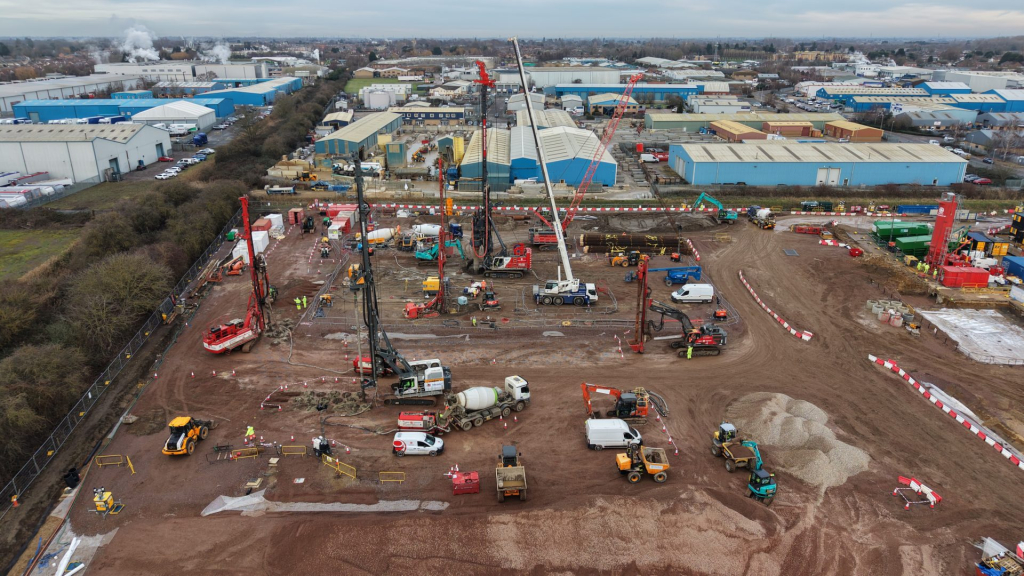
Bachy Soletanche, Menard and Dunton Environmental collaborated to deliver a fully integrated geotechnical solution for principal contractor Kanadevia Inova, building on a strong, established relationship across previous projects.
The scope included:
- A watertight underground waste bunker formed using a jet grouted plug and secant piled wall
- A Trenchmix® cut-off wall for the areas where the formation level had to be reduced 2m below the working platform
- Ground improvement across the wider site using controlled modulus columns (CMCs) and bi-modulus columns (BMCs)
- Enabling, platform maintenance and support works associated with the ground improvement and foundation package
DESIGN DEVELOPMENT AND VALUE ENGINEERING
Bachy Soletanche held overall design responsibility and worked closely with Kanadevia Inova’s consulting engineers to optimise the jet grouted plug, secant piled wall and ground improvement designs to suit the site’s high groundwater conditions.
A key value engineering initiative saw the cut-off wall methodology change from a traditional slurry wall to Bachy Soletanche’s patented Trenchmix® technique. Compared to the traditional method, this approach saved approximately 140 tonnes of powdered materials, reduced water use by around 1,800m³ and eliminated approximately 1,800m³ of waste arisings, delivering cost savings of around £80,000 and associated carbon reductions.
GEOTECHNICAL CONSTRUCTION
Secant Piled Retaining Wall
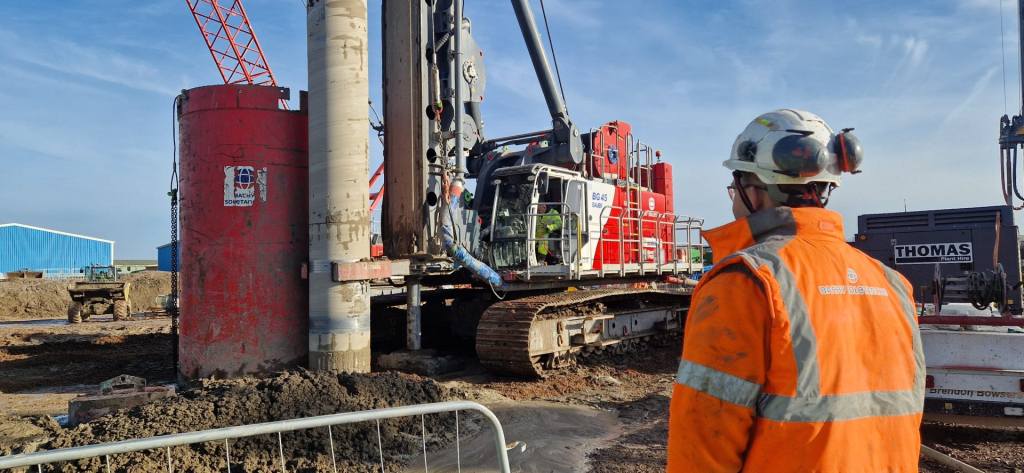
To enable excavation within the waste bunker, Bachy Soletanche constructed a secant piled retaining wall box. This involved the installation of 156 overlapping, cased CFA (continuous flight auger) piles, each 900mm in diameter and ranging from 16.5m to 19.5m in depth, using a Bauer BG45 rig. A guide wall was installed in advance to ensure accurate pile positioning and verticality, while three additional piles were constructed to facilitate the connection between the retaining wall and the Trenchmix® cut-off wall delivered at a later stage.
Jet Grouted Base Plug
Within the secant wall box (waste bunker), Bachy Soletanche installed a 1.5m-thick jet grouted plug at 13.5m depth to prevent groundwater ingress during excavation. This comprised 175 columns, each up to 2.5m in diameter, installed using the double jet grouting method, which incorporates compressed air to enhance erosion and improve mixing efficiency. The team conducted a jet grouting trial ahead of the main works to confirm achievable column diameters and establish the final operating parameters.
Trenchmix® Cut-Off Wall
To further manage groundwater as part of the site’s dewatering strategy, Bachy Soletanche installed a Trenchmix® cut-off wall around the perimeter of the bunker, which tied into the structure at three key locations. Using a TM-80 trencher, the team constructed a 365m-long continuous trench that was 8m deep and up to 470mm thick. This in-situ soil mixing technique produces minimal spoil and offers a more sustainable alternative to a traditional slurry wall.
Ground Improvement
Menard delivered a ground improvement scheme to support the foundations and slabs of over 25 different structures, including the Tipping, Boiler and Turbine Halls, as well as workshops, storage areas, various tanks and crane bases.
Over a four-month period, the team constructed more than 8,500 controlled modulus columns using three rigs. Installed in a tight grid pattern, the columns were 300mm in diameter and ranged from 5m to 15m in depth.
Where deep cut-off levels were required in bunkers and crane bases, Menard used its innovative bi-modulus column system. This works by installing a stone column at the head of the CMC, down to variable depths. Over 2,700 BMCs were installed across the site to facilitate easier follow-on excavation to depths up to 6.5m.
The CMCs and BMCs were installed with bespoke rigs using displacement tools, ensuring no arisings or spoil was produced. The rigs run on HVO fuel and are computer-controlled to ensure concrete use is optimised. To provide further environmental benefit, Menard used ultra-low carbon concrete throughout.
Following installation, Menard carried out 29 plate load tests, confirming that the required design parameters had been achieved. As part of the overall ground improvement package, the team also undertook the setting out and trimming works, providing a streamlined solution for the client.
SITE SUPPORT AND PLATFORM MANAGEMENT
As part of the collaborative delivery with Menard, Dunton’s scope encompassed the provision of support works associated with the ground improvement and foundation package. This included the removal and management of unsuitable materials across the working areas, ensuring the site was prepared to safely accommodate construction operations.
Dunton was responsible for the ongoing maintenance of the CMC and ground improvement working platforms, providing safe and compliant access for specialist plant throughout the programme. In addition, the team delivered all attendances required to support the installation of CMC and piling works, including plant coordination, material movements, platform upkeep, and logistical support to maintain productivity.
Through close collaboration with Menard and the wider project team, the works were completed safely and efficiently, ensuring uninterrupted progress of the foundation installation activities while maintaining high standards of quality, safety and site housekeeping. The coordinated approach contributed to a successful delivery programme and provided a stable platform for subsequent construction activities.
DELIVERY AND COORDINATION
The scale and complexity of the geotechnical package required close coordination between Bachy Soletanche, Menard, Dunton Environmental and Kanadevia Inova. Logistical planning was particularly important during periods of increased cement consumption and extended working hours. To maintain programme certainty, a dual-silo setup was implemented, enabling material supplies to be effectively managed and reducing the risk of delays. Through close collaboration across all parties, the works were delivered safely and efficiently within a busy, multi-contractor environment.
OUTCOME AND CLIENT FEEDBACK
All works were delivered on programme, demonstrating strong collaboration and effective project management throughout.
The team maintained a positive working relationship with Kanadevia Inova, supported by:
- Strong day-to-day collaboration between site teams and management
- Responsive review and approval of design and operational documentation, enabling works to proceed without delay
This project highlights the value of integrated geotechnical delivery, early design optimisation and collaborative working in successfully delivering complex infrastructure in challenging ground conditions.