THE SCHEME
As the only allocated sand and gravel deposit in the London Borough of Redbridge, Fairlop Quarry is a key supplier of construction materials for North-East London. With depleting material reserves, two additional phases of excavation (Phases E and F) were required to extract further deposits. The extension will mean a reliable supply of construction material can continue for another six to seven years, after which the land will be fully restored for agricultural and recreational use.
DESIGN AND PLANNING
Working as Principal Contractor, Bachy Soletanche designed and constructed a low-permeability cut-off wall across the northern boundary of the extension area ‘E’ to prevent the adjacent, contaminated groundwater from entering the quarry during excavation. With an expertise in slurry walls and soil mixing, along with past experience of delivering work at the quarry, Bachy Soletanche provided valued design support to the client during an extended period of early contractor involvement.
Bachy Soletanche proposed the slurry wall technique as an alternative to the originally specified soil-mixing solution. This offered higher permeability; therefore, it enabled the team to reduce the width of the wall from 1,000mm to 600mm, providing both cost and carbon savings. To further the environmental benefits, Bachy Soletanche reduced the amount of cement in the slurry mix by 60% through replacing it with ground granulated blast-furnace slag (GGBS).
CUT-OFF WALL CONSTRUCTION
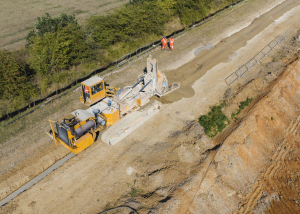
Using a long-reach excavator and a site-batched, low-permeability slurry, Bachy Soletanche began by constructing a cut-off wall that was 1,209m long, 600mm wide and up to 8m deep. To prevent any groundwater influx, the wall was embedded one metre into the underlying London Clay.
With a narrow working platform and restrictions that prevented them from casting the excavated material onto the adjacent topsoil, the team had to mobilise additional equipment to relocate the spoil to an allocated area of site. To protect the topsoil underneath, Bachy Soletanche covered the ground with a layer of geotextile and used 75mm-thick crane mats for vehicle movements.
Works were briefly paused during archaeological excavations, but once Bachy Soletanche regained site access, it was agreed that they would use their innovative Trenchmix® technique to complete the remainder of the cut-off wall as it minimises spoil production and meant that the width of the wall could be reduced. This section of wall stood 709m long, 400mm wide and up to 8m deep. With less material usage and wastage, Trenchmix® saved 63 tCO2e compared to the excavated slurry wall technique.
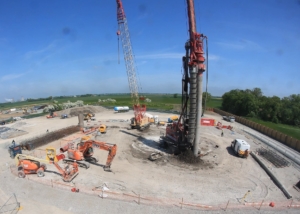
For this second phase of work, Bachy Soletanche invested in new equipment, including the Bauer MAT CMS 45 slurry mixer, which provided greater control over the slurry composition. Before works commenced, the team programmed the mixer with three different compositions to suit the varying ground conditions, which avoided any manual programming during construction.
Despite freezing temperatures halting the site’s water supply for five consecutive days during the first phase of work, the team managed to maximise production later on in the programme to ensure the project was completed on time. For example, in areas with large quantities of gravel and sand, Bachy Soletanche was able to achieve nearly double the targeted outputs, constructing 650m2 of wall in a single shift.
ADDITIONAL WORK
As Principal Contractor, Bachy Soletanche was responsible for all aspects of the programme, including plate load testing, temporary works, security, environmental management, welfare units, traffic management and water quality testing. Bachy Soletanche also worked with its sister company Soil Engineering to install monitoring wells, which were used to verify the efficiency of the barrier. Additionally, Bachy Soletanche took responsibility for diverting a public footpath that ran through the site. This involved levelling the ground using the cut-off wall spoil and fully resurfacing the area, as well as installing fencing and signage along the route.